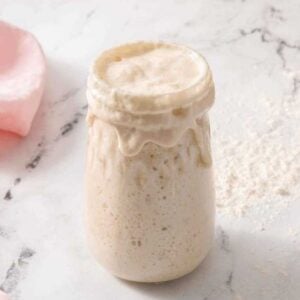
Sourdough Starter Recipe
My straightforward Sourdough Starter guide answers all your questions about how to grow, feed, and maintain your starter. With daily step-by-step instruction, you’ll be making sourdough bread in no time!
Equipment
- Scale (optional)
- Pint- or quart-sized glass container
Ingredients
For the Starter:
- ½ cup whole wheat flour (60g)
- ¼ cup filtered water (60g)
For Each Feeding:
- ½ cup unbleached all-purpose flour (60g)
- ¼ cup filtered water (60g)
Instructions
For the Starter:
- Day 1: In a clean glass jar (at least a pint or larger in size), combine the whole wheat flour and water. Stir together until the flour is fully combined. It should be the consistency of a paste or thick batter. If it’s dough-like, thin with a bit more water.
- Cover the container loosely with the lid and let the jar sit in a warm spot (75-80°F) for 24 hours.
- Day 2: It’s time to check the starter and feed it! Look for any bubbles that have formed on top. If it doesn’t appear bubbly, let the starter sit for another 12 to 24 hours or until you see signs of bubbles. When you do see bubbles or if a greyish liquid has formed on top, continue on with feeding. (This timing will depend on the ambient temperature where the starter is sitting. You may not see any activity within the first 24 hours if it’s cool.)
For Each Feeding:
- Once you see bubbles (this could be on day 2 or after another 24 hours), discard half of the starter, keeping about 60g in the container. Add ½ cup (60g) of all-purpose flour and about ¼ cup (60g) of water to the container, and stir until well combined. Mark the level of the mixture on the side of the container with a rubber band, marker, or piece of tape. Loosely cover and let it rest in a warm spot for another 24 hours.
- Day 3: Check the starter. It should be very bubbly and risen, almost doubling in volume. If you do not see much activity or the starter hasn’t increased in volume at all, continue to let the mixture sit until it does. (This could take another 24 hours.) The starter should start to take on a faint sour smell at this stage as well!
- Once risen, discard half of the starter and feed again with the same amounts of flour and water. Loosely cover and let the starter sit until it has doubled in size. This could be anywhere from 6 to 24 hours.
- Day 4 & 5: Continue discarding and feeding the starter 2 more times after it doubles in volume each time. (You will be creating a bit of discard or waste in this initial phase, but it’s worth it! Once your starter is healthy and active, you can use the discard in other recipes.)
- After the final feeding and rise, your starter is ready to use! It should have developed a pleasantly sour aroma that is easily noticeable when it is fed and active. You can follow my homemade Sourdough Bread recipe to put it to use.
Maintaining the Starter:
- To store your starter long-term, keep it refrigerated so it stays healthy. Before storing, discard and feed one more time. Let the starter sit in a warm spot just until it starts to rise (about 2 hours), then cover tightly and refrigerate. Feed it by repeating the same process of discarding and adding flour and water once every week to keep the starter healthy. The cold will slow the yeast down so that they feed on the flour more slowly. When ready to bake again, discard and feed as normal. Let the starter sit in a warm place until doubled in size. Use as directed in the recipe.
Notes
- Whole-grain rye flour can be used in place of whole wheat flour for the development of a starter. Like whole wheat flour, rye flour is full of micronutrients that help feed the good bacteria and yeast in a sourdough starter, fostering healthy and fast fermentation.
- Be sure to always use filtered water. Tap water or water containing chlorine can kill the good bacteria in your starter, either killing a healthy starter or keeping one from forming to begin with.
- A starter that has been stored in the fridge or left on the counter for too long can form a brown or greyish liquid on top. This is called “hooch” and is actually alcohol that forms when the yeast finishes feeding on the fresh flour. As long as there is no mold present on the surface, you can pour this off or just stir it back into the starter before feeding it.