This post may contain affiliate links. Please read our disclosure policy.
After testing thousands of recipes, here are the tools I genuinely reach for every day, every week, and once in a while. Plus, the ones I’d skip if I were starting over.
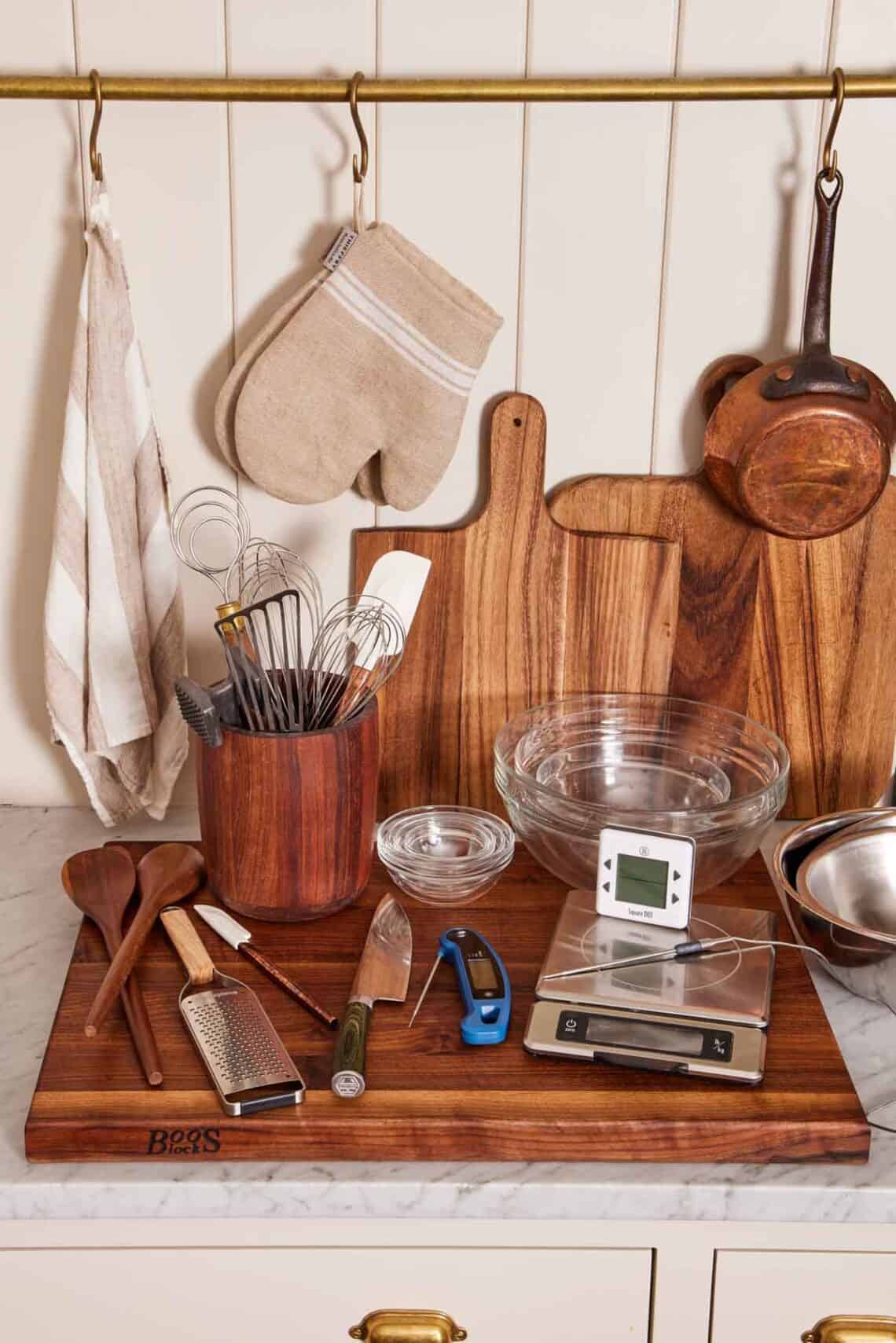
Walk into any kitchen store, and you’ll see a wall of tools you “need.” A garlic peeler. An avocado slicer. A pancake batter dispenser. Most of those things will live in a drawer for two years and then go to the thrift store. The truth is, most home cooks need about a dozen tools that they reach for daily, another ten or so for weekly use, and a small handful of specialized pieces for specific recipes. Past that, you’re likely buying clutter. This guide is the list I’d hand to someone who’s setting up a kitchen from scratch—the tools that actually earn their counter and cabinet space, organized by how often you’ll actually use them.
I’ve cooked thousands of recipes for this site, my cookbooks, and my YouTube channel. Some tools have been in my kitchen for fifteen years and still get used every week. Others I bought, used twice, and gave away. The list below is honest about both. There are no affiliate-driven additions, no “you absolutely must have this” sales pitches, and no items I included just to round out a number. If something’s on the list, it’s because I actually use it!
“I bought a chef’s knife and a digital scale based on John’s recommendations. I also used to get suckered into buying kitchen gadgets I don’t use, and now I’ve stopped. My drawers are emptier, and my cooking is better. This list was so helpful to know what I honestly need and what I don’t!”
Mary Beth
My Decision Framework: Tools By Frequency Of Use
Most “essential kitchen tools” lists give you 50 items in alphabetical order, full of products they are selling, which isn’t useful when you’re deciding what to buy first, and what you really need. Here’s how I’d rank what matters, by how often you’ll actually use it.
| Tier | What it includes | When to buy it |
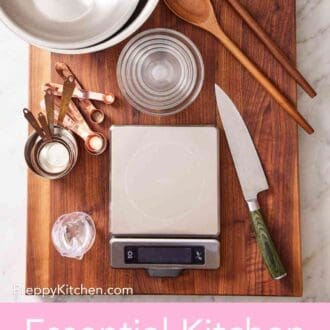
| Daily Use | Chef’s knife, cutting board, wooden spoon, mixing bowls, measuring cups & spoons, kitchen scale | Day one. These are non-negotiable and will set you up for any baking and cooking success. |
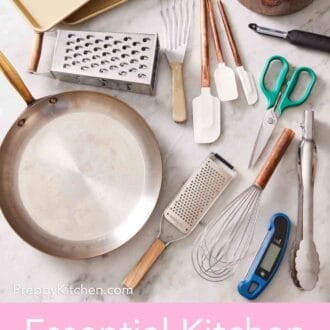
| Weekly Use | Sheet pans, saucepans, microplane, fish spatula, whisk, tongs, spatulas, peeler, box grater, instant-read thermometer, kitchen shears | Within your first month of cooking/baking regularly. |
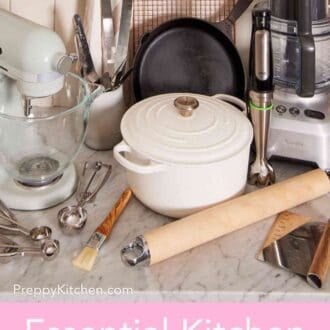
| Occasional Use | Stand mixer, food processor, Dutch oven, cast iron skillet, immersion blender, rolling pin, wire cooling rack, offset spatula, pastry brush, spring-loaded scoop, bench scraper | If you really plan on cooking and baking frequently, these tools make certain tasks easier and are multi-purpose. |
| Specialized | Mortar & pestle, mandoline, Russian piping tips, salad spinner | Buy after a year of cooking, when you know what you actually need. |
| Skip | Garlic press, double boiler, avocado slicer, banana slicer, pancake batter dispenser, novelty gadgets | These solve problems that aren’t really problems. |
The rest of this article walks through each tier with my honest opinion on each tool and what it earns its place doing.
Daily Use: The Six Tools You’ll Touch Every Time You Cook
These are the tools I reach for in nearly every recipe, every day. If you can only buy six things to start a kitchen, these are them.
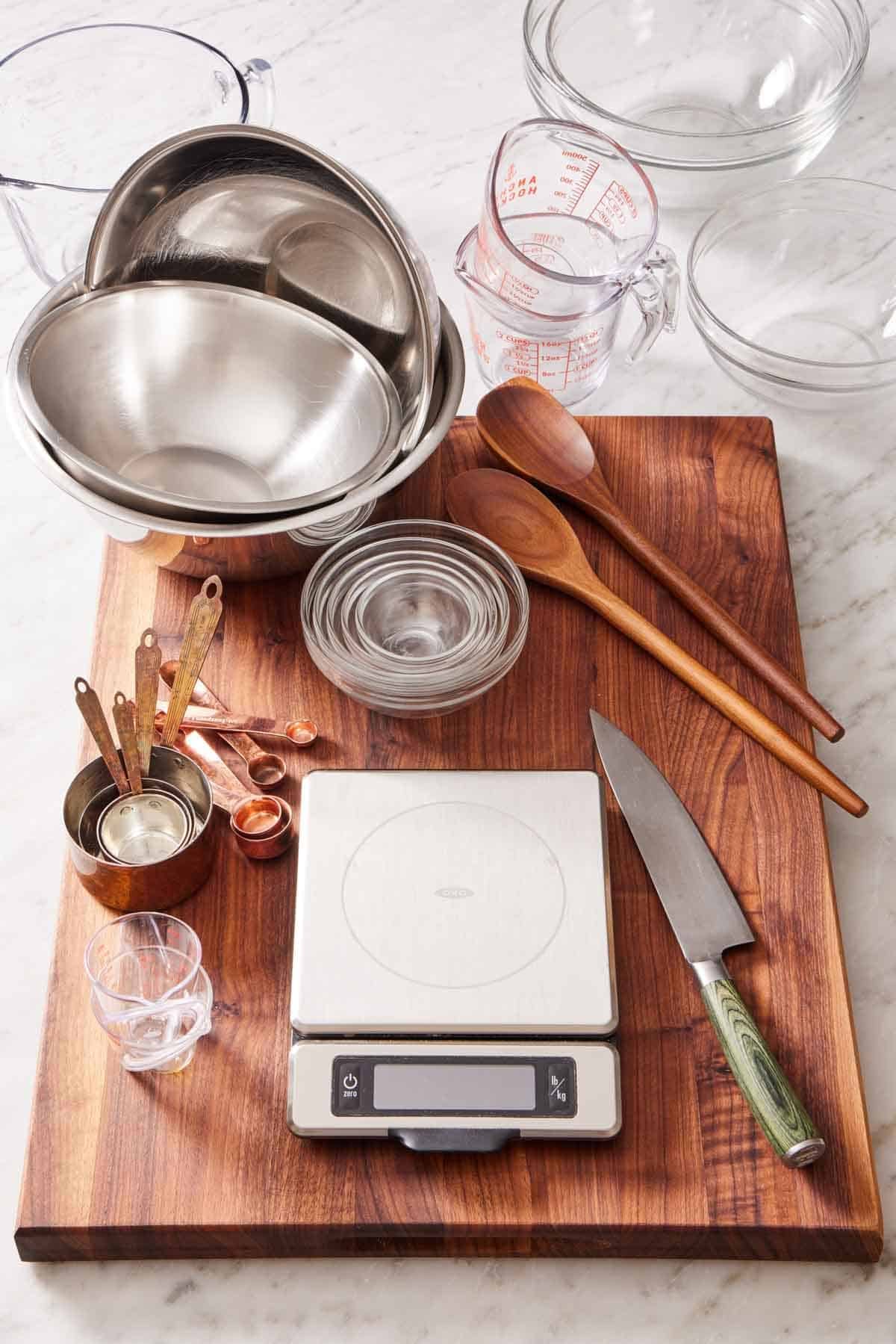
Chef’s knife. A good 8-inch chef’s knife is the single most important tool in any kitchen. It chops vegetables, slices meat, minces herbs, breaks down a chicken, and gets used about 90% of the time you’re prepping food. You don’t need an expensive one—instead, you need one that you can sharpen. A $50 knife you keep sharp will outperform a $400 knife that’s dull. The biggest upgrade most home cooks can make isn’t buying a better knife; it’s learning to keep their existing knife sharp. I have mine sharpened on a whetstone every few months and use a honing rod every time I cook. A serrated bread knife and a small paring knife round out the perfect trio, but the chef’s knife does the heavy lifting.
Cutting boards. Get two: one wooden or bamboo for produce and bread, one dishwasher-safe for raw meat. Wood is gentler on knife edges and looks better on the counter, so you can leave it out. I use a large walnut Boos block for most tasks. Plastic or high-density composite cutting boards are dishwasher-safe and keep cross-contamination contained. I love the Epicurean paper composite boards because they are easy on knives and still dishwasher safe! Size also matters. A tiny cutting board makes general prep miserable. Get one that’s at least 15 by 20 inches. Trust me on this—the upgrade from a small board to a properly sized one is one of the most underrated improvements you can make.
Wooden spoon. A flat-edged wooden spoon—the kind with one straight edge for scraping along the bottom of a pan—is so helpful for every saute, stew, or batch of bolognese. Rounded-end wooden spoons are also great for soups or dishes that don’t have much browning or risk of getting stuck to the pot. Wood doesn’t scratch nonstick pans, doesn’t conduct heat to your hand, and ages beautifully, so it’s a great all-purpose material. I have one that’s been in my kitchen for fifteen years. With an occasional oiling, it’s still going strong!
Mixing bowls. Get a nesting set of 3-4 stainless steel bowls in graduated sizes. They stack, they’re indestructible, they don’t react with acidic ingredients, and they double as ice baths or washing bowls for produce. Glass bowls are nice for beating egg whites where you want to see the structure, but stainless is the most indestructible and the best go-to if you just have one set. (Yes, I use glass bowls in all of my posts—this helps you see the food on camera. Glass bowls are perfectly fine if that’s what you want, but stainless steel will last longer without the risk of chipping.)
Measuring cups and spoons. A nesting set of dry measuring cups, a 1-cup and 2-cup liquid measuring cup with a pouring spout, and a set of measuring spoons (⅛ tsp to 1 tbsp). These get used in every recipe. The biggest mistake I see is using dry measuring cups for liquid (or vice versa). There’s a reason to use each type—see my Academy lesson on How to Measure Ingredients Correctly for the full breakdown.
Kitchen scale. This is the tool most home cooks don’t have and absolutely should. A digital scale with a tare button can cost as little as $20 and immediately makes your baking more consistent and your cooking faster. Recipes I publish always include weights alongside volumes (when appropriate) for a reason—flour measured by volume can vary by 20% between cooks, but flour measured by weight is the same every time, no matter who measures it. Once you start baking by weight, you’ll never go back.
Weekly Use: The Tools That Earn Their Drawer Space
These are the tools you’ll reach for several times a week once you’re cooking regularly. Buy them in your first month, once you know exactly what you want or need for yourself.
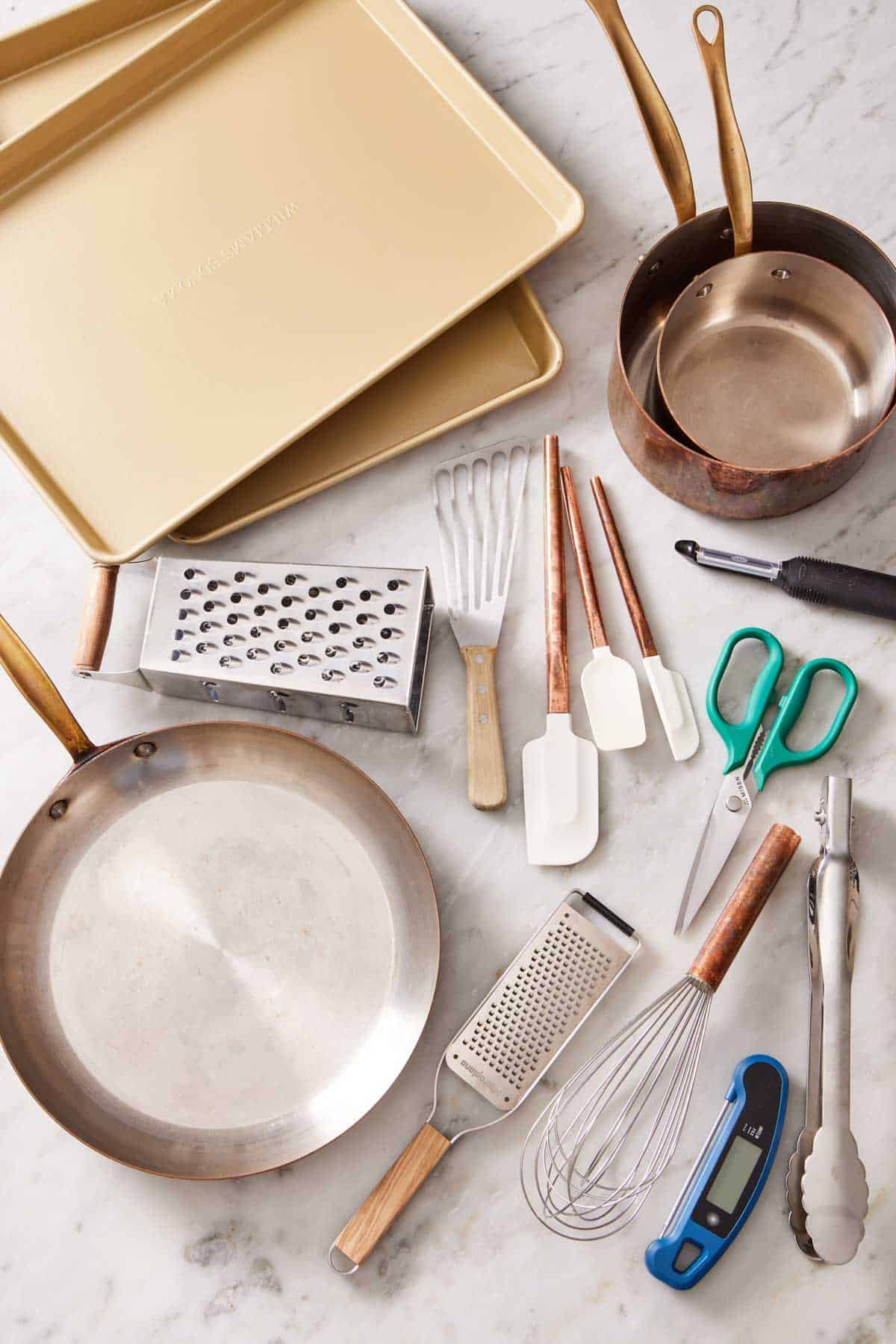
Sheet pans. Half-sheet pans (18×13 inches) are the workhorse of any kitchen. Cookies, roasted vegetables, sheet-pan dinners, drying out bread for stuffing, freezing biscuits—they do everything. Get heavy-duty ones; cheap ones warp at high temperatures. Aluminum is a good and less expensive standard, but it isn’t dishwasher-friendly. I use non-stick stainless steel pans from William Sonoma, and they perform well for every task.
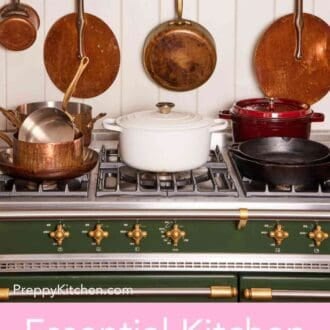
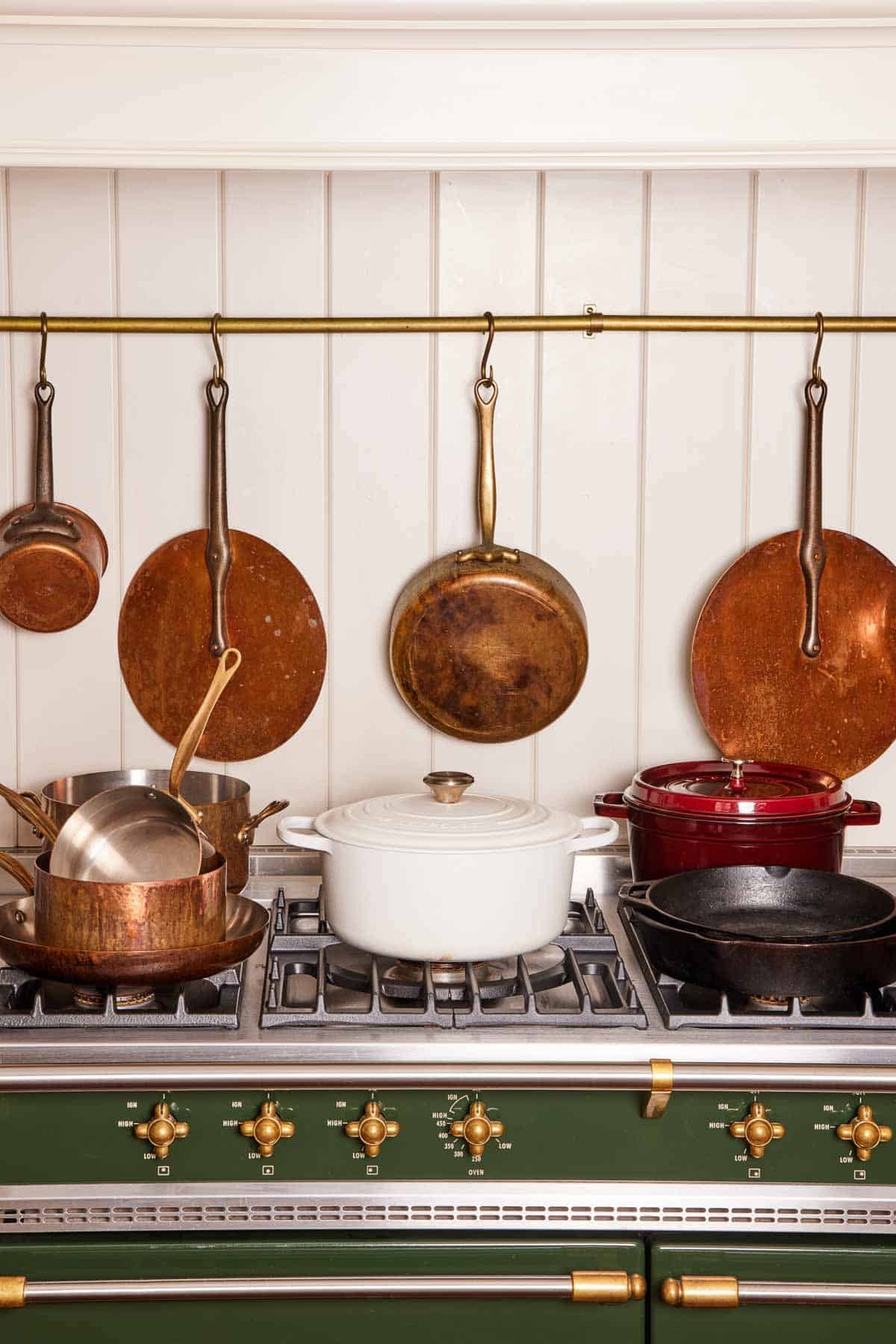
Saucepans. A small (1.5-quart) and medium (3-quart) saucepan or pot covers most cooking. Stainless steel with a heavy bottom for even heating is ideal. Use these for sauces like bechamel and hollandaise, grain cooking, sauce reductions, and melting chocolate. Skip nonstick saucepans—the coating doesn’t survive high heat or metal whisks. I love my copper pots, but a stainless steel set works very well and can be found affordably across many brands.
Microplane zester. A handheld zester that turns hard parmesan, lemon zest, garlic, ginger, and nutmeg into a fine, fluffy snow. It’s the secret weapon in a lot of restaurant kitchens for seasoning recipes or adding that finishing flourish to a dish. I use mine in nearly every recipe with citrus or hard cheese. When I call for lemon zest in a recipe, I use a Microplane to zest the fruit. For grated parmesan cheese, the same thing—the Microplane zester gets it fine enough to melt into an alfredo sauce or whisk up for Caesar dressing. Microplane is a brand that makes all kinds of graters and zesters of different sizes, but the classic zester is an all-purpose workhorse and what I keep in my drawer.
Fish spatula. Despite the name, it’s not just great for fish. The thin, flexible, slotted blade is the best tool for flipping or moving anything delicate: pancakes, fried eggs, cookies, salmon, chicken cutlets. Once you have one, you’ll find yourself reaching for it constantly.
Whisk. A medium balloon whisk works well for whipping cream and beating egg whites that need a lot of air worked in. A French whisk is thinner with more wires, and is my most frequently used. It’s perfect for tasks like mixing dry ingredients, whisking together batters, beating whole eggs, and emulsifying vinaigrettes. If you only have one, choose a stainless steel, mid-sized whisk (9-11 inches). A tiny one doesn’t move through large quantities well, and an oversized one is unwieldy in a small bowl. I love my OXO 11” French whisk for general tasks.
Tongs. Long stainless tongs with silicone tips. They’re an extension of your hand for flipping, transferring, plating, and pulling pasta out of boiling water. A 9-inch pair is great for tossing salads and general flipping or plating. A 12-inch pair works well for handling pasta, any food that might splatter in a skillet or pot, or on the grill.
Silicone spatula. Many people think these are just for baking, but they make so many tasks easier! It’s the best tool for the perfect scrambled eggs (won’t scratch your skillet and the egg doesn’t stick to the spatula), scraping any food out of a pot, bowl, or pan (nothing is left behind), or stirring things cooking on the stove or roasting on a sheet pan (high-heat resistant and scratch-proof across all pan materials). I prefer spatulas without a spoon-shape or scooped head—I find food just gets trapped in there, and you need another tool or your hands to clean it off.
Vegetable peeler. I have both a Y-shaped peeler and a swivel-style peeler. Most chefs swear by the Y-shape for its speed and ergonomics. I actually prefer the swivel style. I think this is more personal preference on what feels best for you! Either design peels potatoes, carrots, apples, and works as a quick veggie ribbon-maker for salads. It also makes strips of citrus zest for cocktail garnishes or seasoning.
Box grater. A 4-sided box grater shreds cheese and vegetables at different sizes. It can also do citrus zest (though a microplane wins for that task). I prefer it over a food processor for small cheese amounts because there’s nothing to clean. Get one with a flat top so it stands stably on a cutting board.
Instant-read thermometer. A digital instant-read thermometer is the difference between guessing and knowing. Steaks at 130°F for medium-rare. Bread at 200°F when fully baked. Custards at 170°F before they curdle. A digital thermometer that reads temperatures quickly is one of the best investments you can make, and they can be as little as $30. I use a Lavatools Javelin PRO 2-second thermometer. Thermowoks and other brands make excellent thermometers, too. Just make sure that the one you buy says it reads “ultra-fast” or within 1-3 seconds for the best results.
Kitchen shears. Heavy-duty scissors that can break down a chicken, snip herbs, open packaging, and cut pizza. Get ones that disassemble for proper cleaning.
Occasional Use: The Specialized Tools Worth Owning
These are tools worth owning, but only after you’ve been cooking regularly enough to know you’ll use them. If you buy these on day one, half of them collect dust. Some of them are also larger investments, and you want to make sure you will use them before making the purchase.
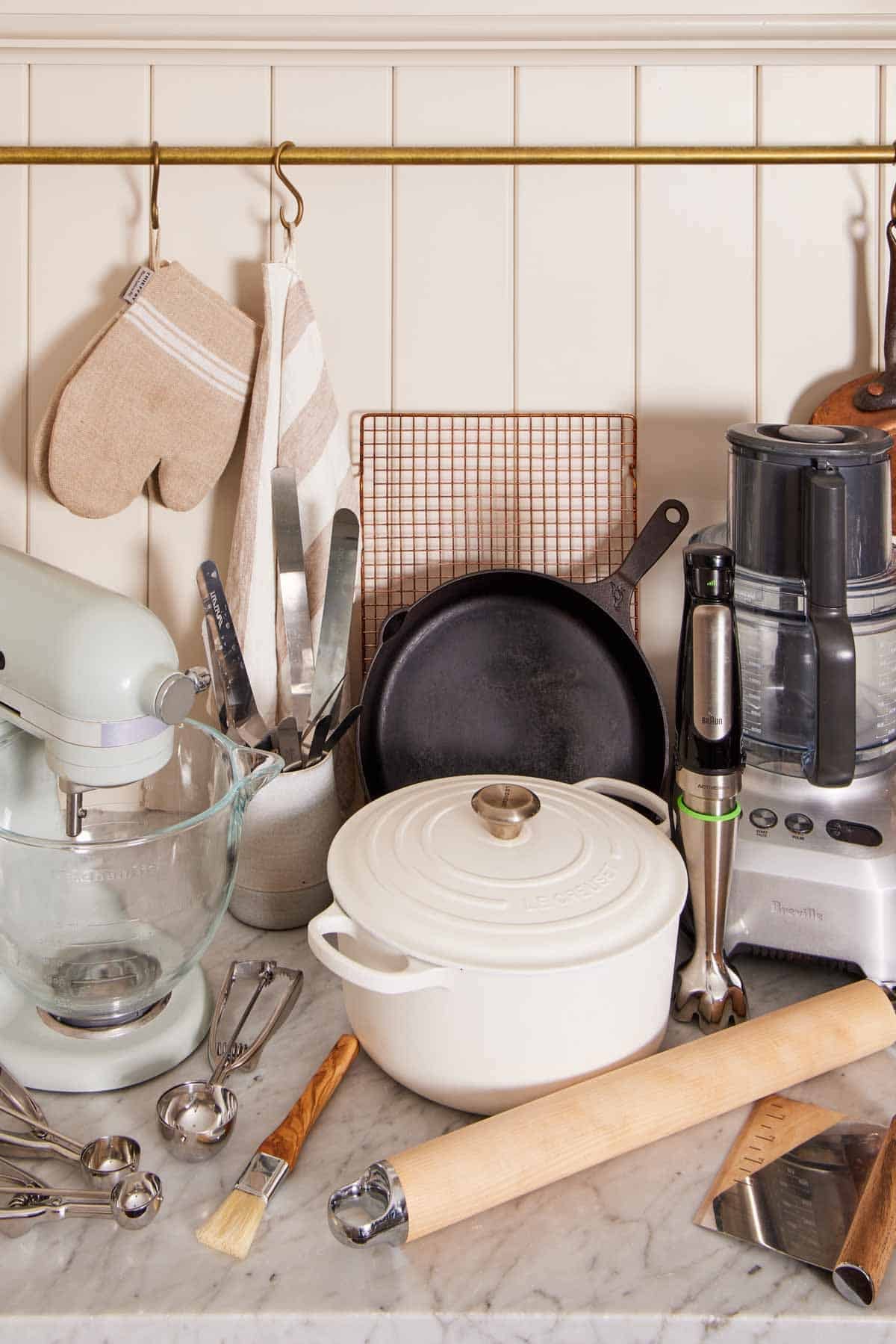
Stand mixer. A KitchenAid (or equivalent) is a real investment, but for anyone who bakes regularly, it’s earned. It creams butter for cakes, whips egg whites for royal icing, kneads bread dough, makes whipped cream fast, and frees your hands for everything else. If you bake more than twice a month, it pays for itself in time saved. If you don’t, a $30 hand mixer does 80% of what a stand mixer does for a fraction of the price. (Kneading bread dough is about the only task a hand mixer can’t do that a stand mixer can.)
Food processor. Useful for pesto, hummus, pie dough, breadcrumbs, and chopping large volumes of vegetables. A 9-cup model is generally the right size for home cooks. A mini food processor can be helpful for chopping a small handful of nuts or grinding freeze-dried fruit into a powder, but they’re not big enough for most jobs. If you really want to upgrade your kitchen appliances, go bigger, or you’ll end up wishing you’d bought the larger one. I use a Breville 16-cup food processor because I often make double batches of pie dough or use it to chop veggies for meal prep. A 9-cup will make a batch of hummus, double pie crust, or chop a few cups of veggies easily, so you definitely don’t need one as big as mine. (Breville also makes a 9-cup version!)
Dutch oven. A heavy enameled cast iron pot for braises, stews, chili, sourdough bread, and deep-frying. Le Creuset and Staub are beautiful and last generations; Lodge makes a perfectly good version for a quarter of the price. A 5-7 quart size is right for most home cooks.
Cast-iron skillet. A 10- or 12-inch cast iron skillet does what no nonstick can: it sears a steak, it goes from stovetop to oven, it bakes a skillet cookie, and it lasts forever. The seasoning gets better with every use. Lodge makes a skillet for under $30. There are more expensive brands out there if you want something different—shop around and see what you want. I have a Lodge 10-inch and a Smithey 12-inch cast iron skillet, and they both work great.
Immersion blender. Sticks directly into a pot of soup or sauce to puree without dirtying a blender or worrying about transferring hot liquids. It’s also the best tool for fixing a bechamel that’s gone lumpy and making homemade mayonnaise.
Rolling pin. A French-style tapered wooden rolling pin (no handles) is what I use for pie crust. The tapered shape gives you better control when rolling the dough into a circle with even thickness. I also use a handless straight pin (with and without thickness guides) for cookie doughs. They help roll an even thickness when the shape of the dough doesn’t matter. American-style rolling pins with handles work fine, but a handleless style is easier to use!
Wire cooling rack. These stainless steel grids work great for a variety of uses, not just cooling pans and food fast (as the name suggests). They keep waffles crispy instead of steaming directly on a pan, fried foods drain oil instead of sitting in a pool of it on a plate, and a roasted chicken is lifted up and turns crispy instead of soggy from sitting in its own juices. Get one that is oven-safe so you can use one rack for cooling cookies and roasting meat.
Offset spatulas. The thin, angled stainless steel blades are helpful for frosting cakes as well as numerous other kitchen tasks. They lift cookies from baking sheets, help remove muffins from pans, release cheesecakes from the side of the springform, spread fillings for lasagna, or smooth the tops of batters. Plus, I love using them like a butter knife for simple tasks like spreading peanut butter or jam on toast! A small 4-5 inch offset is my go-to; adding a larger 8-10 inch one makes a great all-purpose pair.
Pastry brush. Most commonly, my pastry brushes are used for applying an egg wash on pies and pastries, cream on top of scones or biscuits, or soaking cake layers with syrup. If you grill or make a lot of roasts, you can also use them for basting. They work excellently for brushing oil or softened butter on pans for greasing. If you bake and cook, I recommend having a brush for savory and sweet applications, so you don’t accidentally add garlic flavor to your pie crust.
Spring-loaded scoop. If you love baking, you need one of these! I use a variety of scoops for evenly portioning doughs and batters. It’s great for muffins, cupcakes, and cookie dough. It also helps you easily portion frosting or fillings between cake layers. My two most-used scoops are #30 scoop (2 tablespoons) and #16 scoop (¼ cup).
Bench scraper. A flat metal scraper for handling sticky doughs, dividing portions, and cleaning a work surface. Bakers swear by these. They are also the best tool to move chopped veggies and herbs from a cutting board to a bowl or pot. You can fit more on the blade than a knife, and you’ll save your knife’s edge from dragging across the board.
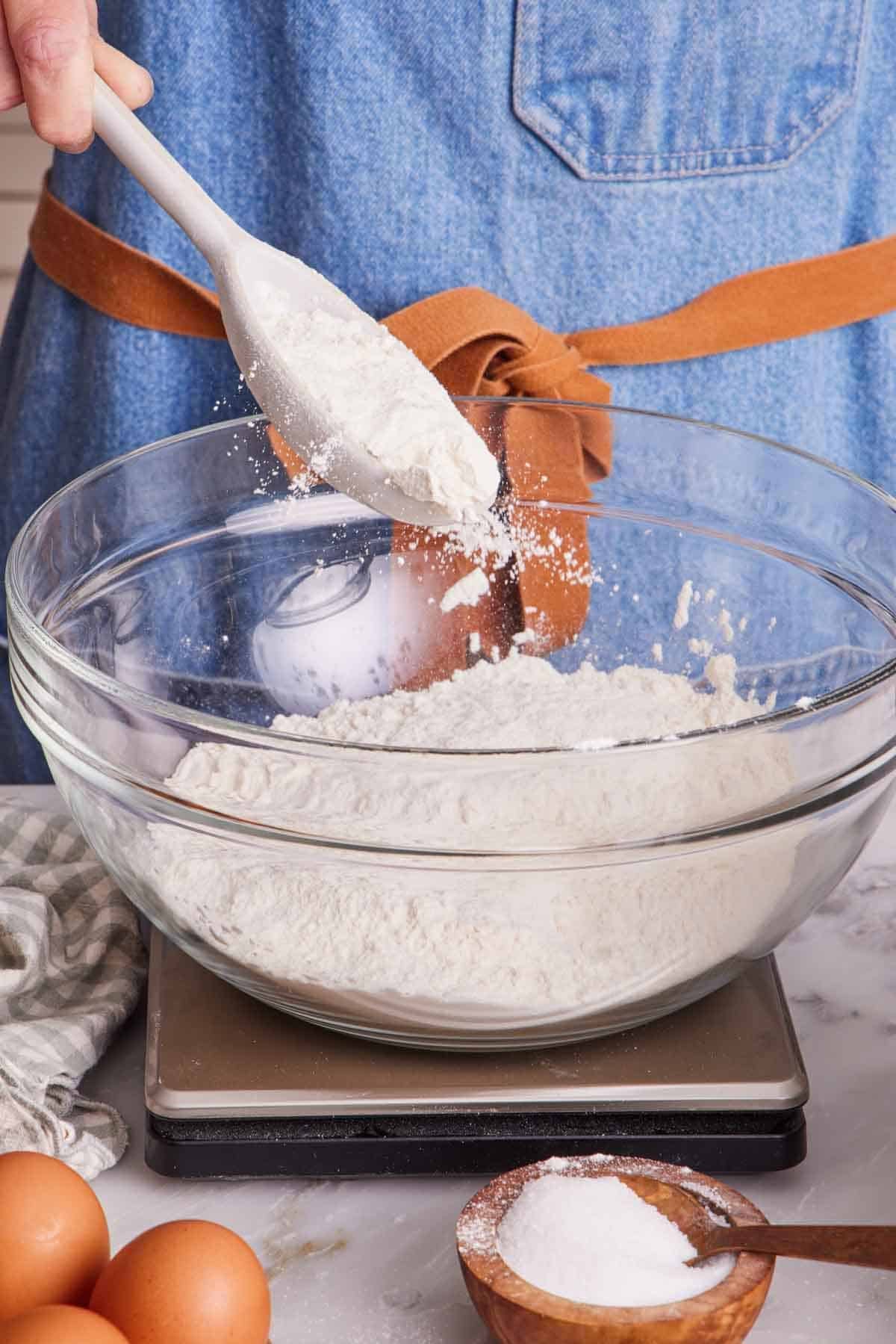
Specialized Tools (Buy After A Year If Needed)
These are nice-to-haves that earn their place once you’ve been cooking long enough to know what you actually want.
- Mortar and pestle. For grinding whole spices and making pesto by hand. The stone version is heavy and stable; ceramic is lighter and chips.
- Handheld lemon squeezer. I use this fairly often. It is not a kitchen necessity, and really only does one task, so I put it in the specialized tools list. But if you squeeze a lot of lemons or limes for cocktails, salad dressing, or to add to recipes, consider picking one up.
- Oven thermometer. If you bake a lot like me, this might go in your weekly use list. But not everyone uses their oven often. If you do, these are inexpensive but great to have, so you know your oven is baking at the right temperature, or if you need to adjust it.
- Mandoline. For paper-thin slices on potato gratin, cucumber salads, and moussaka. I personally do not own one of these because I don’t like the risk of using them, but many home cooks love them, so I put it on the list for you. If you choose to own one, please always use the hand guard or wear a cut glove. (I cannot emphasize this enough!)
- Special piping tips. Russian piping tips, petal tips, ruffle tips, etc. These are used for advanced cake and cupcake decorating. You only need these if you really love frosting cakes and cupcakes! (See russian piping tips guide as an example.)
- Salad spinner. Skip if you don’t make many salads. If you do, it’s a very helpful tool. Wet greens dilute dressing and make for a sad salad. A $20 spinner solves this and doubles as a colander for washing other fresh fruits and produce.
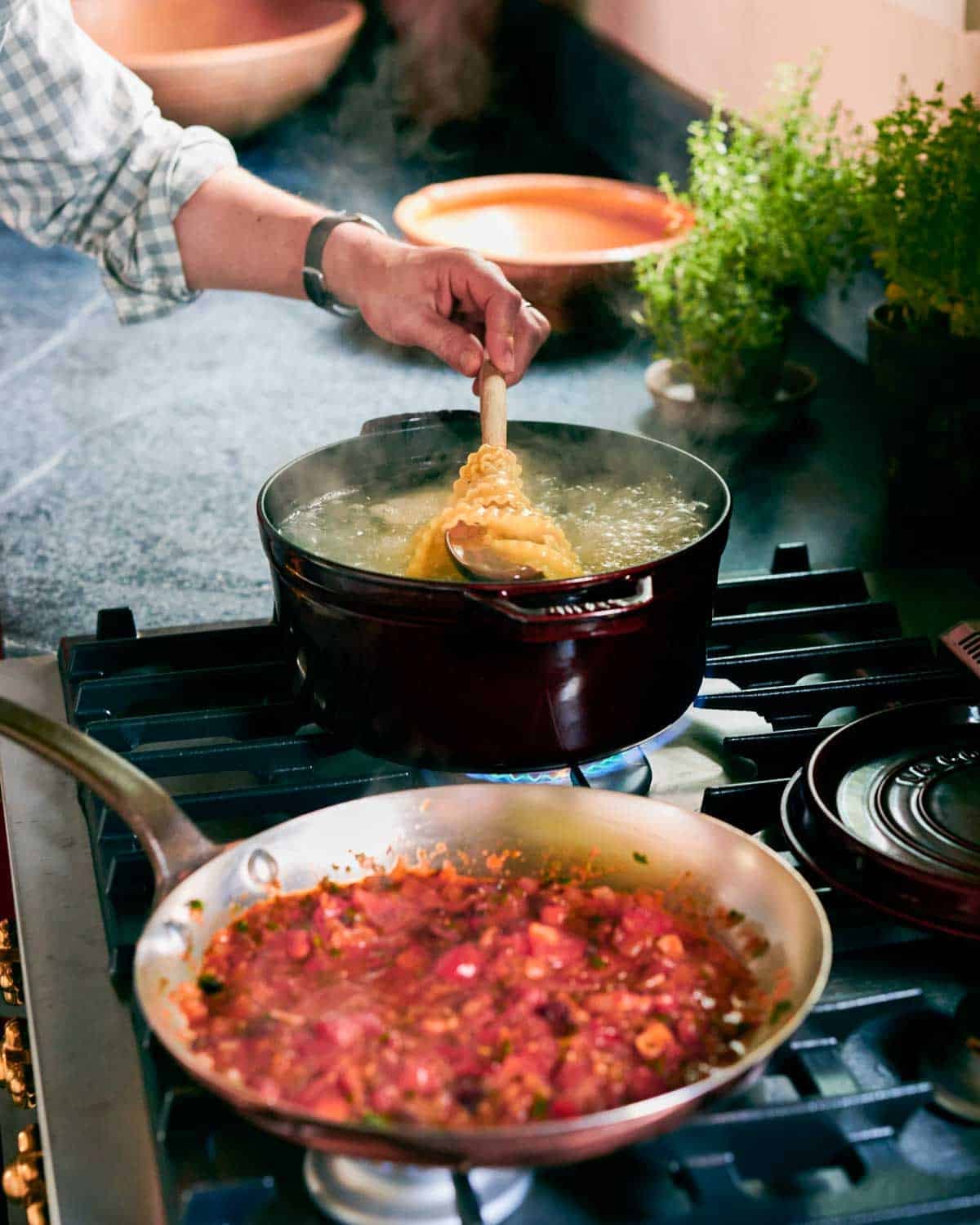
Tools You Probably Don’t Need
The kitchen aisle is full of single-use gadgets that solve problems you don’t actually have. Here’s my honest list of things to skip:
- Garlic press. A chef’s knife and the side of the blade smashes garlic faster and gives you better texture control. The press also leaves bits behind that you have to clean out—and it’s tough and annoying to do.
- Double boiler. A metal or glass bowl over a saucepan works just as well for melting chocolate or making hollandaise. A dedicated double boiler really isn’t essential.
- Avocado slicer/banana slicer/strawberry huller. All three jobs are solved by a knife.
- Egg slicer. Again, you just need a knife.
- Pancake batter dispenser. A measuring cup with a spout or a pitcher does the same thing without taking up precious storage space.
- Specialty fruit corer. Do you really need an apple slicer or corer for cutting up apples? No, a knife works. BUT, I do use an apple corer for other tasks like removing the center of cupcakes for fillings. I also like to bake apples whole with the core removed and stuffed with sugar and spices. So, this is more of a “maybe/ if you want it!”
- Single-use spice jar sets with pre-printed labels. Cute, but they assume you’ll have exactly those spices and not ones not in the set. Generic small jars with handwritten labels are more flexible. Or just use the jars the spices came in!
- Most novelty gadgets in the front of the kitchen store. If you’ve been cooking for a year and don’t already wish you had it, you likely don’t need it.
The principle: a good kitchen runs on a small number of versatile tools that do many things, not a large number of single-use gadgets. Every gadget you skip is counter space, drawer space, and money saved.
A Word On Quality vs. Budget
You don’t need to spend a fortune to have a great kitchen. Here’s how I’d allocate budget if I were starting over:
- Spend more on: chef’s knife, cutting board, sheet pans, instant-read thermometer, and kitchen scale. These get used daily, and a quality version lasts decades.
- Spend mid-range on: saucepans, cast iron, Dutch oven, food processor, stand mixer (when you commit). These are workhorses where build quality matters, but the marginal returns drop above mid-tier brands.
- Spend less on: wooden spoons, mixing bowls, measuring cups, peelers, whisks, tongs. These work virtually the same at $5 as at $50.
Many new cooks do the opposite: they buy a very nice set of mixing bowls, an expensive Dutch oven or high-priced pans, and then get a cheap knife set. You can always upgrade items as you go, deciding what you really want and how much those items get used.
Frequently Asked Questions
A good chef’s knife and a quality cutting board. If you can only own two good kitchen tools, those are the two. Everything else builds on top of those. A sharp knife and a stable cutting surface make you faster, safer, and more confident—and they get used in nearly every savory recipe you’ll ever make.
In order of how often you’ll use them: a chef’s knife, a cutting board, mixing bowls, measuring cups and spoons, a kitchen scale, a wooden spoon, a sheet pan, a saucepan, a skillet, and an instant-read thermometer. With these ten, you can cook 95% of the recipes you’ll encounter. Everything beyond these is either for occasional use or specialized.
You can fully equip a working kitchen for around $300-500 if you’re strategic. Spend the bulk of that on a quality 8-inch chef’s knife ($50-100), a large wooden cutting board ($30-50), a set of half-sheet pans ($30), a skillet ($30), a kitchen scale ($20-30), and an instant-read thermometer ($30-75). The remaining budget covers basic stainless steel saucepans, mixing bowls, measuring cups, and a few utensils. Bigger investments—stand mixer, dutch oven, food processor—can be added over time as you discover what you need.
For some categories, yes, but for most, no. A $200 chef’s knife is meaningfully better than a $20 chef’s knife (better steel, better balance, longer-lasting edge). A $50 wooden spoon is just as functional as a $10 wooden spoon. The categories where quality genuinely matters are: knives, cookware that conducts heat (cast iron, heavy-bottom saucepans and pots), some appliances (stand mixer, food processor), and any tool you’ll use daily for years. The categories where brand barely matters are: utensils, mixing bowls, measuring cups, peelers, and most accessories. Spend up where it earns its keep, and don’t spend up where it doesn’t.
More Tutorials To Try
Cross-Academy lessons:
- Academy: Salted Vs. Unsalted Butter — everything you need to know about the difference between them and why using a certain kind matters in your cooking and baking.
- Academy: How To Measure Ingredients Correctly — the practical application of your scale and measuring tools based on specific ingredients
Recipes that put these tools into practice:
- Pound Cake — kitchen scale, stand mixer, loaf pan
- Bechamel Sauce — heavy saucepan, whisk
- Royal Icing — stand mixer
- Sugar Cookies — rolling pin, sheet pans
- Chili Recipe — Dutch oven
- Pie Crust — French rolling pin, bench scraper (food processor, optional)