This post may contain affiliate links. Please read our disclosure policy.

A practical guide to the salts in your kitchen—what each one actually is, how the major types compare, the critical Diamond Crystal vs. Morton difference that ruins so many recipes, and which salt to reach for in cooking versus baking.
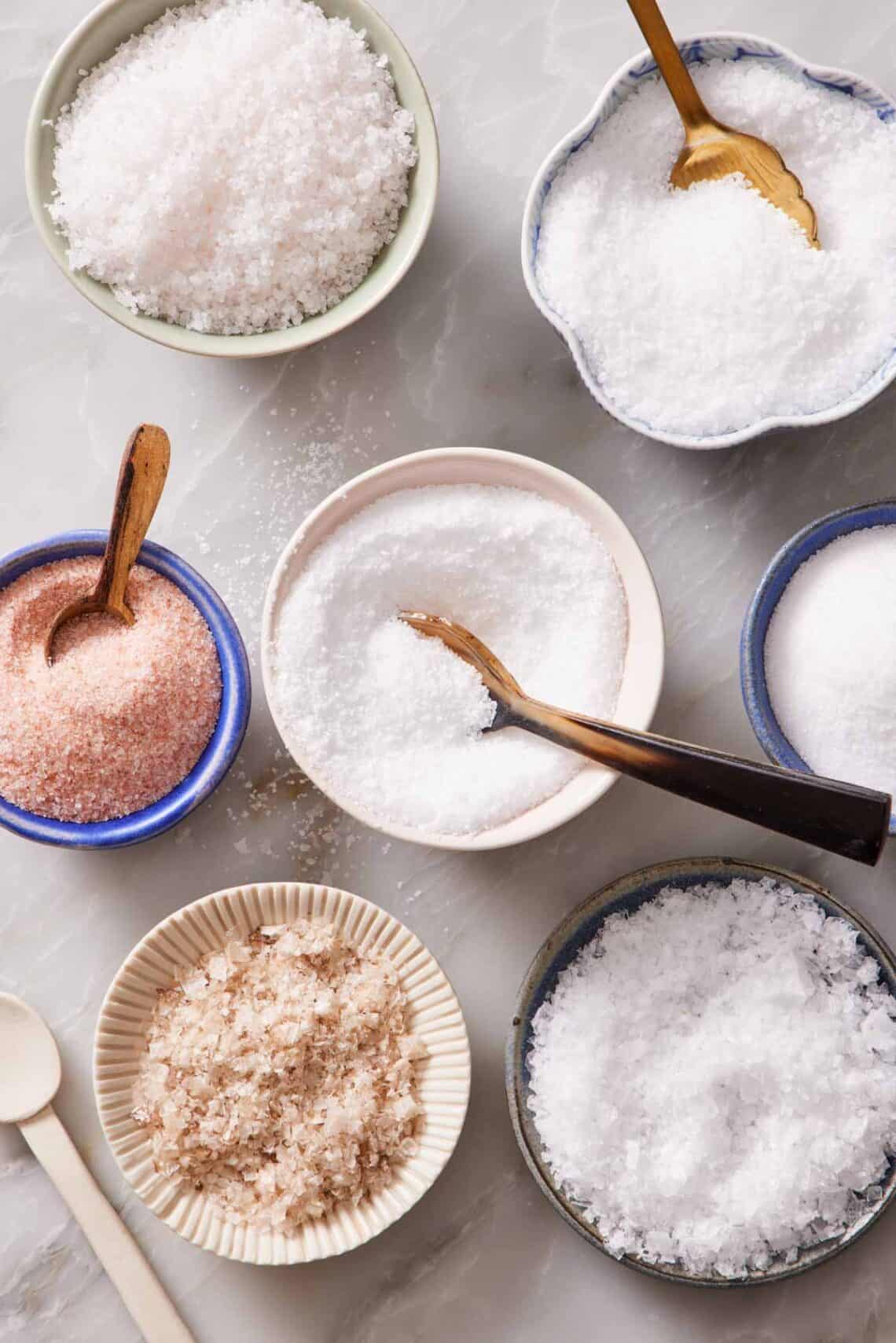
If you’ve ever had a recipe call for “1 tablespoon of kosher salt” and felt like the result was too salty or not salty enough, the problem might not be your palate (or the recipe). It’s that “kosher salt” doesn’t actually mean one thing. A tablespoon of Morton kosher salt weighs roughly twice what a tablespoon of Diamond Crystal kosher salt weighs, even though both boxes say “kosher salt” on the label. That single discrepancy has caused more recipe failures than any other salt-related mistake. Bon Appétit actually started listing amounts for both brands because so many readers were ending up with inedible food. And this is only one nuance between salts. The salt aisle has more variation than almost any other staple in the kitchen.
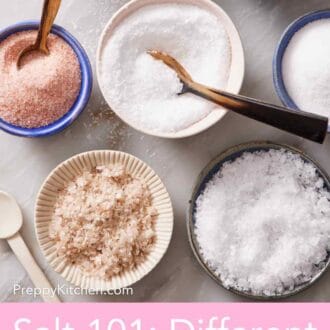
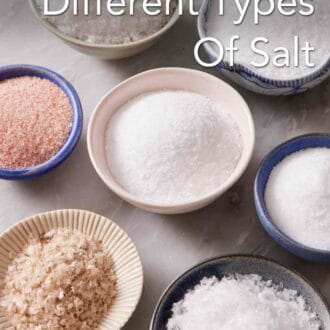
In this lesson, I’ll walk you through the main types of salt you’ll encounter: table, kosher, sea salt, flaky finishing salts like Maldon, fleur de sel, Himalayan pink, and smoked salt. We’ll cover what each is actually made of, how they compare, when to use each one, and the precise conversions you need when a recipe calls for one type and you only have another. By the end, you’ll know exactly which salt to grab for any cooking or baking task, and why the salt you choose matters more than most cooks realize.
“My cookies kept tasting under-seasoned even though I was following the recipe. Switching from Diamond Crystal to Morton’s fine sea salt (which is what John uses) finally fixed it. I wish someone had explained this difference to me years ago!”
Liam
What Is Salt?
Salt is a mineral made primarily of sodium chloride (NaCl), a compound of sodium and chlorine. It’s essential to life. Humans need it to regulate hydration, nerve function, and muscle contractions. It’s also been one of the most important ingredients in cooking for thousands of years.
In the kitchen, salt does three things: it seasons food (enhancing flavor and balancing sweetness, acidity, and bitterness), it preserves food (by drawing out moisture and inhibiting bacteria), and it chemically modifies ingredients (drawing moisture from meats during brining, strengthening gluten in dough, controlling yeast activity in bread). Different types of salt do these jobs differently, which is why the salt you choose matters.
All edible salts are sodium chloride. What makes one salt different from another is the source it’s harvested from, the size and shape of its crystals, and what trace minerals or additives are present. Those three variables affect taste, texture, and how the salt behaves in your cooking.
The Main Types Of Salt
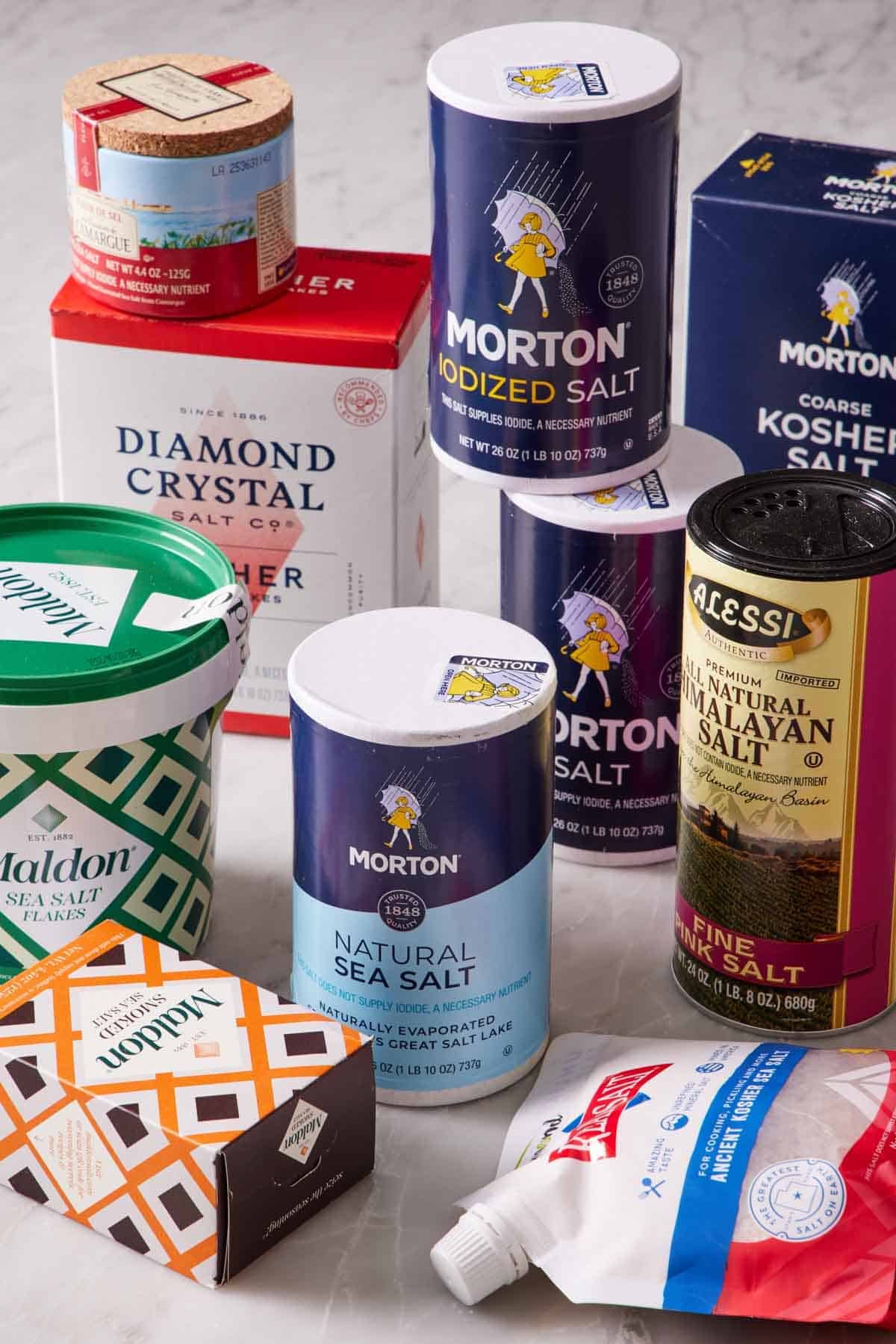
The salt aisle has gotten complicated, and a lot of the variety is more about marketing than meaningful difference. Here are the salts that actually matter for home cooking and baking:
| Salt Type (weight per tsp*) | Source | Texture | Best For |
| Table salt (~6g) | Mined or evaporated, refined | Fine, uniform | General cooking, baking |
| Iodized table salt (~6g) | Mined or evaporated, refined + iodine added | Fine, uniform | General cooking |
| Morton kosher salt (~5g) | Mined or evaporated | Coarse, dense flakes | General cooking, seasoning meat |
| Diamond Crystal kosher salt (~3g) | Evaporated (uses a proprietary Alberger process) | Coarse, hollow pyramidal flakes | General cooking, seasoning meat (chef’s favorite) |
| Fine sea salt (5-6g) | Evaporated seawater | Fine, uniform | General cooking, baking |
| Flaky sea salt (Maldon) (~2g) | Evaporated seawater | Large, thin, crunchy flakes | Finishing |
| Fleur de sel (~3g) | Hand-harvested seawater (France) | Moist, delicate flakes | Premium finishing |
| Himalayan pink salt (~6g; fine) | Mined (Pakistan) | Fine to coarse, varies | General cooking, finishing |
| Smoked salt (2-3g) | Cold-smoked sea salt | Coarse or flakes | Grilling, finishing |
*Weight per teaspoon is approximate and varies by brand and grain size. The key insight is that a teaspoon of Diamond Crystal weighs roughly half what a teaspoon of table salt does. This means you need more Diamond Crystal by volume to match the same level of saltiness.
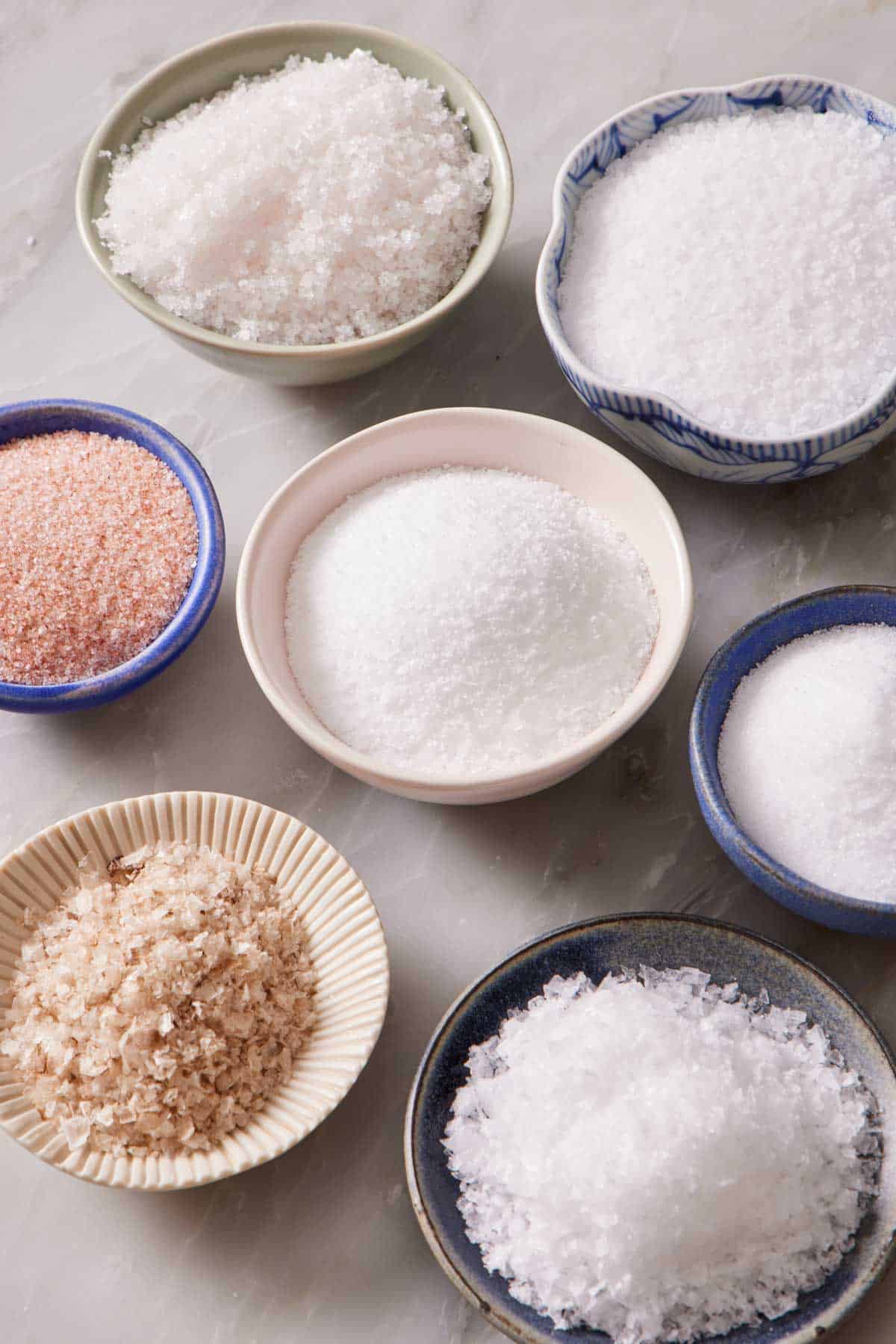
Table salt (regular and iodized). The most common salt in American kitchens, it is heavily refined to remove trace minerals, then ground to a uniform fine grain. It often contains anti-caking agents (like calcium silicate) to prevent clumping in humid weather. Iodized table salt has potassium iodide added—a public health measure to prevent iodine deficiency. I do not recommend iodized salt for baking, as it can give a metallic taste to your baked goods. Non-iodized table salt is fine for any baking application. Overall, table salt is multi-functional, neutral in flavor, and dissolves quickly.
Fine sea salt—my everyday standard. This is my go-to salt for recipe development! When a recipe simply calls for “salt,” I have used Morton’s fine sea salt. It’s made from evaporated seawater and ground to a uniform fine grain with a similar density to table salt (~17g per tbsp). Trace minerals from the source water give some sea salts a faint mineral or briny taste. But I find it to have an overall better or cleaner taste than table salt because it’s minimally processed. The fine texture dissolves quickly, making it good for both baking and general cooking. Sea salt (in all its forms) is the salt type I reach for most often in my own kitchen.
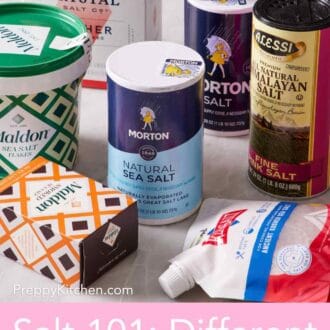
Kosher salt. This coarse-grained salt is named for its traditional use in koshering meat (drawing out blood). It has no religious significance itself; the name simply describes its function. Two American brands dominate kosher salt options: Morton (denser, heavier flakes) and Diamond Crystal (lighter, hollow pyramidal crystals). The two brands produce very different results in the same recipe—see the dedicated Diamond Crystal vs. Morton Kosher Salt section below.
Flaky sea salt (Maldon and others). Large, thin, crunchy flakes, designed to sit on top of finished food rather than dissolve into it. The defining feature is the crunch and the bright, sudden saltiness when a flake hits your tongue. Don’t use flaky salt to season during cooking—it’ll dissolve, and you’ll lose what makes it special. Reserve it for finishing.
Fleur de sel. Hand-harvested from the surface of evaporation ponds in France (literally translates to “flower of salt”). This salt has delicate, slightly moist flakes with a subtle mineral character. It is generally the most expensive (typically $15–25 for a small jar) and used sparingly as a finishing salt for special dishes. It’s worth having for occasional use, but not a daily go-to.
Himalayan pink salt. Mined from ancient salt deposits in Pakistan. The pink color comes from iron oxide and other trace minerals naturally present in the salt. Functionally, it is similar to other rock salts—the much-touted health benefits over regular salt are largely marketing. According to Harvard Health, the trace mineral content is too low to matter nutritionally. It’s a perfectly good salt; just don’t pay premium prices expecting mineral magic.
Smoked salt. Typically, a sea salt that’s been cold-smoked, usually over hardwoods like alderwood, hickory, or applewood. This adds a smoky character without overwhelming the salt. It’s useful in barbecue rubs, on grilled meats, or as a finishing touch on roasted vegetables. I even love it sprinkled on chocolate chip cookies and brownies.
Kosher Salt vs. Sea Salt: What’s The Difference?
This is the question I get asked more than any other salt question. The short answer:
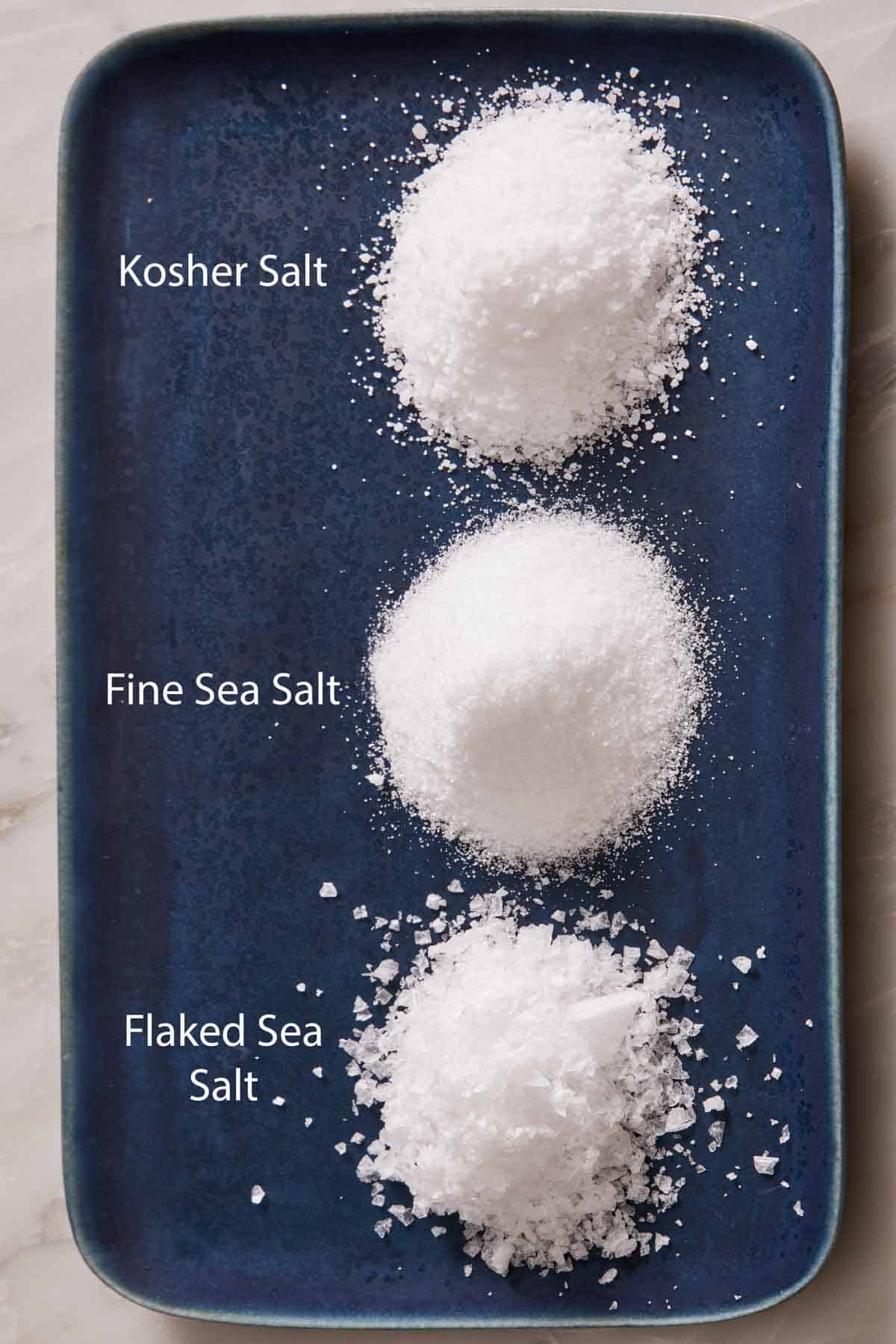
Kosher salt is generally mined from underground deposits or evaporated from brine. Its coarse, flaky texture draws moisture from the surface of meat efficiently, but makes it harder to dissolve.
Sea salt is harvested by evaporating seawater. The flavor can carry trace minerals from the source water that give sea salts a slightly more “complex” or briny taste than mined salts. Sea salt comes in two main grain sizes that are very different in use: fine sea salt (which behaves like table salt) and flaky sea salt like Maldon (which is a finishing salt, not a cooking salt).
For most cooking purposes, the practical difference between coarse sea salt and coarse kosher salt is texture, not flavor. They behave nearly identically in a recipe. The reasons cooks reach for one over the other are usually:
- Kosher salt: preferred by chefs for general cooking and seasoning meat because the larger flakes are easier to pinch and distribute by hand, and they dissolve at a moderate rate (gradual seasoning rather than instant saturation).
- Fine sea salt: preferred for baking because the uniform fine grain dissolves easily and predictably into doughs and batters.
- Flaky sea salt: only used for finishing, where the texture is the whole point.
The healthier choice? Neither is meaningfully healthier than the other. All edible salts are predominantly sodium chloride; trace mineral content is too small to make a real nutritional difference. Choose based on flavor, texture, and recipe context, not health claims.
Why I use fine sea salt over kosher salt in most recipes
Since table salt is what most people keep in their kitchens, I want to ensure my recipes are the most successful across any kitchen. Fine sea salt measures the same as table salt (1:1 per teaspoon), so you will get the same results from either one. I default to sea salt because I prefer the flavor over table salt.
Many bloggers, brands, and cookbooks have shifted to kosher salt because of restaurant influence, but it isn’t the main salt most home cooks keep on hand. And because the kosher salt brands vary so much between them, you either have to have a specific brand on hand or do substitution math. Otherwise, it causes failures in the kitchen, turning what should be an enjoyable time into a frustrating experience. Many of my older recipes used kosher salt. I made the switch in recent years after feedback from readers, and decided that using fine sea salt keeps things simple and is the most successful for home cooks or bakers across any kitchen.
Kosher Salt vs. Table Salt
The difference here is bigger and matters more for everyday cooking.
- Texture. Table salt is fine and uniform; kosher salt has large, irregular flakes. Kosher salt’s flakes are easier to pinch and sprinkle by hand, which is why most professional cooks prefer it for seasoning meat and finishing dishes.
- Density. Because kosher salt’s flakes are larger and irregular, a teaspoon of kosher salt weighs less than a teaspoon of table salt—usually about 5g for Morton kosher and 6g for table salt. Diamond Crystal kosher is even lighter at ~3g per teaspoon. This means you typically need more kosher salt by volume to match the same level of saltiness from table salt.
- Additives. Table salt usually contains anti-caking agents and (often) added iodine. Kosher salt is typically additive-free.
- Dissolution speed. Table salt dissolves almost instantly; kosher salt dissolves more gradually. This can matter, depending on the task, like flavoring a buttercream (you want it to dissolve quickly) versus dry brining a steak (slow dissolving helps draw out moisture more slowly for a more flavorful steak).
The practical takeaway: if a recipe was developed using kosher salt and you only have table salt, use about 75% of the called-for amount (replacing Morton) or 50% (replacing Diamond Crystal). If a recipe calls for table salt and you only have kosher salt, increase to about 1¼ tsp Morton kosher per 1 tsp table salt, or 2 tsp Diamond Crystal per 1 tsp table salt.
For the precise reasoning behind these conversions and how to weigh salt accurately rather than trusting volume, see Academy: How To Measure Ingredients Correctly.
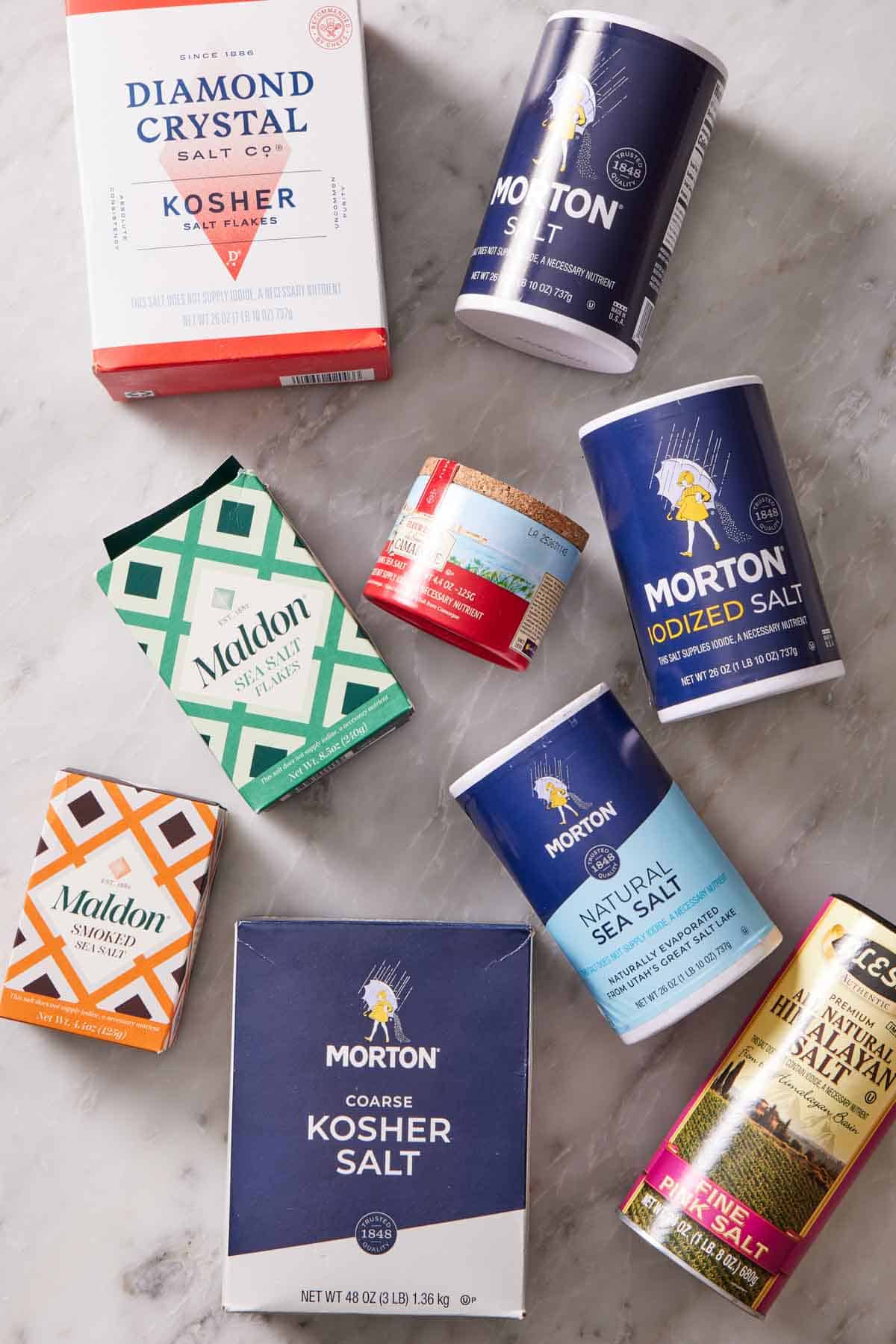
Sea Salt vs. Table Salt
For most cooking purposes, fine sea salt and table salt are functionally similar—same fine grain, similar density (about 6g per teaspoon for both), both dissolve quickly, both can substitute 1:1 in most recipes.
The differences are subtle:
- Source. Sea salt is evaporated from seawater; table salt is mined from underground deposits or solution mined and evaporated, then refined.
- Trace minerals. Sea salt retains small amounts of magnesium, calcium, and potassium from the source water, which gives it a slightly more complex flavor than the pure NaCl of refined table salt.
- Additives. Table salt is typically refined and often iodized. Sea salt is minimally processed and rarely contains additives.
For baking, fine sea salt and table salt are interchangeable 1:1. For everyday cooking, the same is true. The exception is flaky sea salt—that’s a different category (a finishing salt) and shouldn’t be substituted for table salt in cooking applications. Like I mentioned earlier, I now use fine sea salt in all of my recipes (unless noted otherwise) because these two seamlessly substitute one for the other.
Diamond Crystal vs. Morton Kosher Salt: The Critical Difference
This is the most consequential salt fact for anyone who cooks from American recipes.
A teaspoon of Diamond Crystal kosher salt weighs roughly half what a teaspoon of Morton kosher salt weighs (~3g vs. ~5g). Both boxes say “kosher salt,” but that’s a significant difference. Most recipes don’t specify which brand of kosher salt they use, and a recipe written for one tastes very different when made with the other.
Why are they so different? The crystal structure itself is different. Diamond Crystal makes hollow, pyramidal flakes through a unique evaporation process called the Alberger method. Morton makes denser, more rectangular flakes by pressing salt granules through high-pressure rollers. In the same teaspoon volume, you get more salt by weight from Morton because the crystals are denser and pack more tightly. A cup of Morton’s is nearly twice as salty as a cup of Diamond Crystal.
I measured the same volume of both salt brands on the same diamond scale (a high-sensitivity scale) to show you the exact difference. For 1 tablespoon of salt, Diamond Crystal weighed 9.04g and Morton’s weighed 17.83g—that’s almost twice as much!
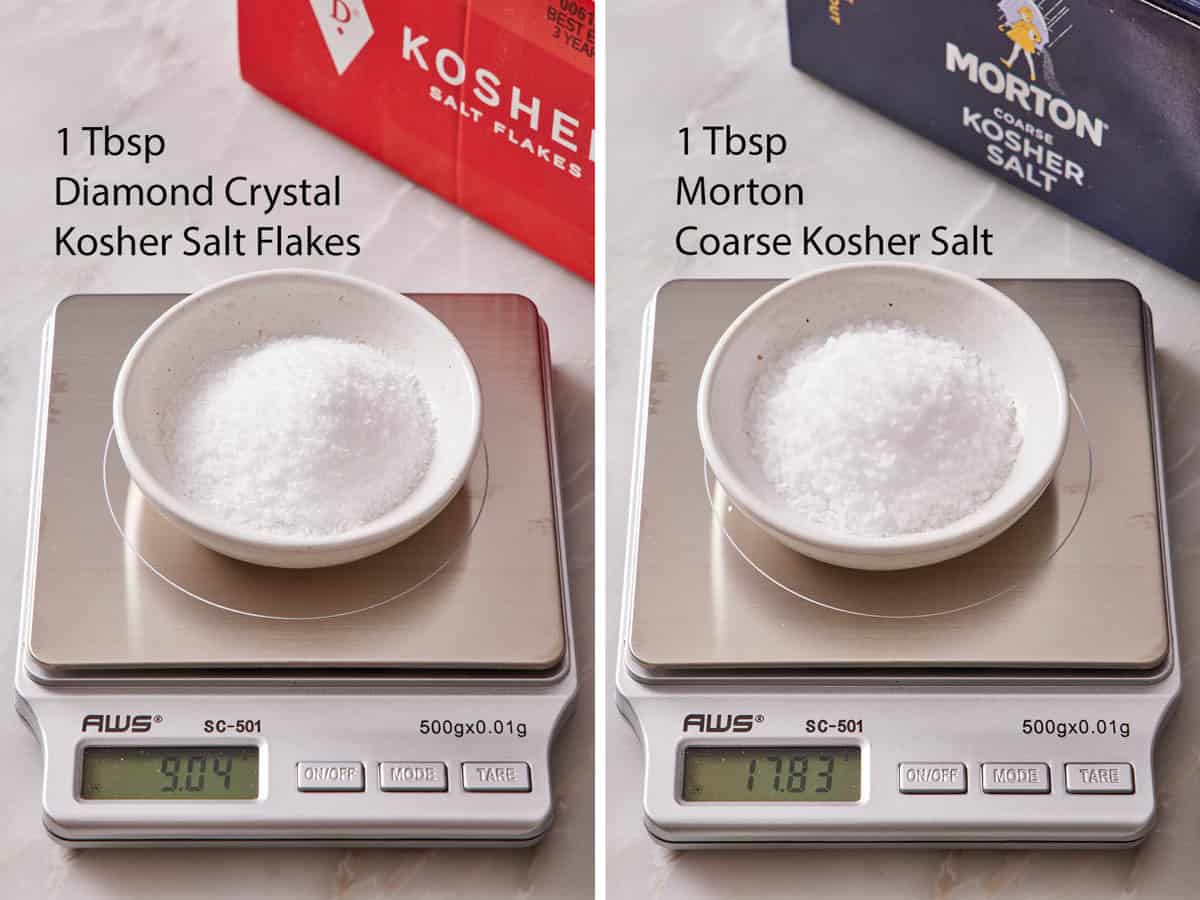
What this means in practice:
- A recipe calling for “1 tablespoon kosher salt” can produce a properly-seasoned dish with Diamond Crystal but a dramatically over-salted dish with Morton.
- The reverse is also true: a recipe developed with Morton tastes flat and under-seasoned if you make it with Diamond Crystal.
- Many professional chefs and cookbook writers default to Diamond Crystal because the lighter weight makes over-salting harder when seasoning by hand.
This isn’t a minor issue. Bon Appétit’s test kitchen reported readers complaining about overly salty pork chops. Their investigation traced it back to brand substitution. The magazine now publishes two salt measurements in recipes where it matters: for example, “1 tablespoon Diamond Crystal or 1½ teaspoons Morton.” Serious Eats specifies Diamond Crystal in every recipe where salt quantity matters. Cook’s Illustrated recommends: when following a recipe developed with Diamond Crystal kosher salt, decrease the volume by 25%. As you can see, there’s a wide range of brands that also cite this difference. (Again, it’s why I typically stick to fine sea salt in my recipes!)
The conversion:
- 1 tsp Morton kosher salt = about 1½-1¾ tsp Diamond Crystal kosher salt
- 1 tsp Diamond Crystal = about ½-⅔ tsp Morton kosher
- 1 tsp Morton fine sea salt = ~about 2 tsp Diamond Crystal kosher salt
Best practice: check the cookbook or recipe author’s note. Many cookbooks and publications (Salt Fat Acid Heat, Bon Appétit, Serious Eats) explicitly use Diamond Crystal. My Preppy Kitchen recipes use Morton’s fine sea salt as the default in baking and general cooking, and Morton’s kosher salt where coarse-grain texture matters (brines, dry rubs, finishing meat before searing). When you swap brands or types of salt without converting, you’re cooking a different recipe than the one tested.
When in doubt, weigh your salt. Weight isn’t brand-independent—8g of salt is 8g of salt regardless of crystal size. See Academy: How To Measure Ingredients Correctly for the full weighing methodology and why scale measurement removes this whole class of error.
Which Salt To Use For Cooking
Different cooking applications call for different salts. Here’s a quick reference.
Sautéing, sweating vegetables, building flavor early. Kosher salt or fine sea salt. The heat helps dissolve either grain size easily, so you can taste as you season. Avoid flaky finishing salts (you’ll waste the texture).
Seasoning meat for searing or roasting. Kosher salt. The coarse flakes adhere well to the surface, draw out moisture for better browning, and dissolve as the meat cooks. The larger flakes help draw out moisture more slowly, too, so the salt has time to penetrate the meat for better flavor and texture. Salt at least 30-40 minutes ahead (ideally several hours or overnight) for the best flavor.
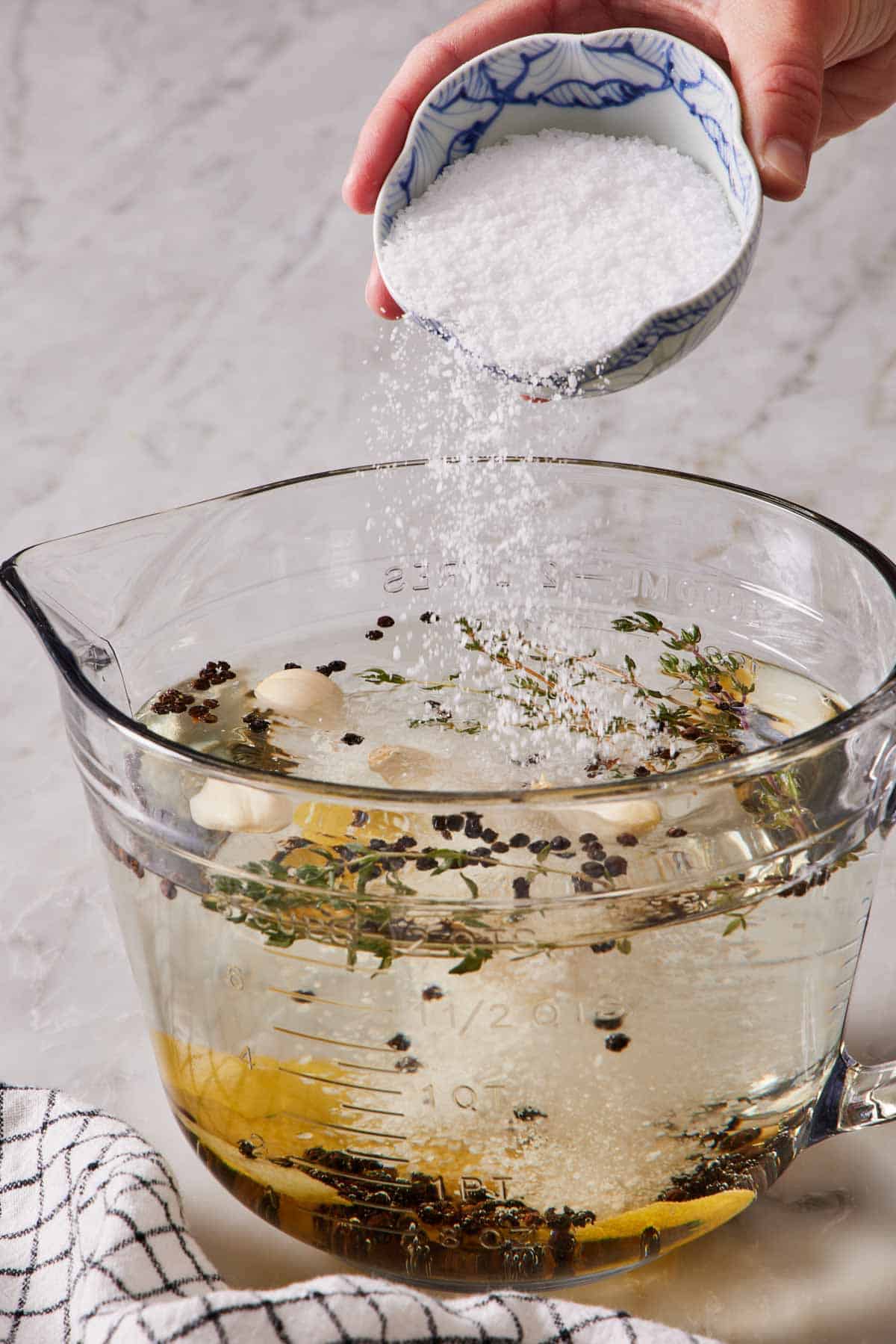
Brining (turkey, chicken, pork). Salt brand matters more here than almost anywhere else in cooking—the volumes are large enough that brand-substitution mistakes are catastrophic. My turkey brine recipe specifies the brand and gives weights in grams precisely because of this. See my turkey brine recipe for the full brine math (1 tablespoon/15g salt per 1 cup/240g water) and the How to Cook a Turkey lesson for context on when to brine.
Pasta water. Any salt works since it’s dissolving in boiling water—table salt or Morton fine sea salt is fine because it’s cheap and dissolves instantly. The Italian convention is 10g of salt per liter of water (about 1 tablespoon of Diamond Crystal or 2 teaspoons of fine sea salt per liter).
Soups, stocks, and sauces. Kosher salt or fine sea salt is added gradually as the flavors build. Always taste before final seasoning—simmering evaporates liquid, which concentrates salt, and you can ruin a sauce in seconds with one wrong sprinkle.
Finishing (after cooking). Flaky sea salt (Maldon), fleur de sel, or smoked salt. Sprinkle on top of grilled meats, salads, roasted vegetables, and even chocolate desserts. The crunch and sudden burst of saltiness is the entire point.
Salads. Fine sea salt or kosher salt distributes evenly through the dressing. Flaky finishing salt sprinkled on top of a composed salad adds visual and textural interest.
Set out the type of salt you’re cooking with before you start—this is mise en place 101. See Academy: Mise En Place for the full framework.
Which Salt To Use For Baking
Baking is where salt choice matters most precisely, because doughs and batters don’t get tasted along the way the way savory cooking does. The wrong salt amount is locked in by the time the bread or cookie is baked.
For most baking—cookies, cakes, breads, pastries—fine sea salt is the default. My recipes specifically use Morton’s fine sea salt. The uniform fine grain dissolves completely into batters, and the roughly 6g per teaspoon density matches what most baking recipes are calibrated to.
Table salt is interchangeable 1:1 with fine sea salt in baking. If you only have table salt, it works.
Kosher salt in baking works fine if the recipe was written with it specifically (and ideally specifies the brand). Substituting kosher salt 1:1 for fine sea salt in a baking recipe will give you slightly under-seasoned results because of the volume-to-weight difference. If you’re swapping, increase by ~25% (Morton kosher) or ~80–100% (Diamond Crystal). Denser kosher salt also doesn’t dissolve the same way as fine salt, so keep that in mind with things like frostings or glazes.
Flaky finishing salt on baked goods is one of the most underrated upgrades. A pinch of Maldon on top of:
- Chewy Chocolate Chip Cookies: the flaky salt against the chocolate and brown sugar is what makes a good cookie great. Sprinkle on each cookie just before baking, or right out of the oven.
- Millionaire’s Shortbread: Maldon on top is essential here. The salt-caramel-chocolate combination really elevates the bars.
- Lemon Bars: a tiny pinch on the cooled bars before slicing amplifies brightness and balances the sweetness. If you find them too sweet for your personal taste, this is a great upgrade for you.
- Cinnamon Rolls: Maldon flakes on top of the glaze cut through the sweetness and add a bakery-style finish.
- Brownies and blondies: same principle as cookies. Adds dimension and balances the sweetness.
- Dulce de Leche: a finishing pinch transforms it from sweet sauce to salted dulce de leche, which is the version most people actually want.
The general rule: fine sea salt in the dough; flaky salt on top.

Salt Conversions & Substitutions
When a recipe specifies a salt you don’t have, here are the volume conversions that work:
| If the recipe calls for… | To Substitute… | Adjust Volume Amount… |
| Table salt | Fine sea salt | 1:1 |
| Table salt or fine sea salt | Morton kosher | Use 1¼ as much |
| Table salt or fine sea salt | Diamond Crystal kosher | Use 2x as much |
| Fine sea salt | Table salt | 1:1 |
| Morton kosher | Table salt or fine sea salt | Use ¾ as much |
| Morton kosher | Diamond Crystal kosher | Use 1½-1¾ as much |
| Diamond crystal kosher | Morton kosher | Use ½-⅔ as much |
| Diamond crystal kosher | Table salt or fine sea salt | Use ½ as much |
To do the math: Multiply the original recipe volume by the conversion amount. For example, to use Morton kosher salt in place of 1 teaspoon of table salt, multiply 1 x 1.25 = 1¼ teaspoons. To use table salt in place of 1 teaspoon Morton kosher salt, multiply 1 x .75 = ¾ teaspoon.
Don’t substitute flaky finishing salts for cooking/baking salts by volume. This is where the conversion math breaks down because the texture is so airy and is hard to accurately and consistently measure in a scoop. Use flaky salt only as a finishing salt that you can sprinkle by hand.
The most accurate substitution method: convert by weight, not volume. All of this confusion goes away if you weigh your salt! 5g of Morton kosher, 5g of Diamond Crystal kosher, and 5g of table salt all season the same—the volumes are different, but the weight is constant. See my Academy: How To Measure Ingredients Correctly lesson for more on weight-based measurement. Here’s a simplified weight chart for salt varieties for easy reference:
| Salt Type | Weight per Tsp |
| Table salt | ~6g |
| Iodized table salt | ~6g |
| Fine sea salt | ~5–6g |
| Morton kosher salt | ~5g |
| Diamond Crystal kosher salt | ~3g |
| Flaky sea salt (Maldon/ plain and smoked) | ~2g |
| Fleur de sel (finishing) | ~3g |
| Himalayan pink salt (fine) | ~6g |
How To Store Salt
Salt is essentially indestructible. It doesn’t expire, go rancid, or lose potency over time. The only storage challenges are:
Keep it dry. Moisture causes salt to clump. An airtight container in a dry pantry handles this. Anti-caking agents in table salt help, but don’t always fully prevent humid-weather clumping, so be mindful of storage for it as well.
Keep flaky salts intact. Maldon and other flaky salts lose their texture if jostled, packed, or stored in humid environments. Keep them in a small lidded jar so they don’t get smashed in the pantry.
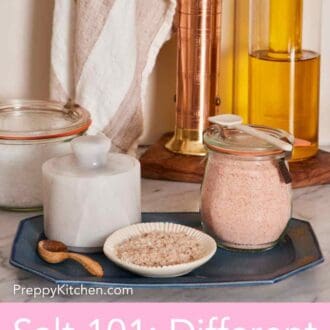
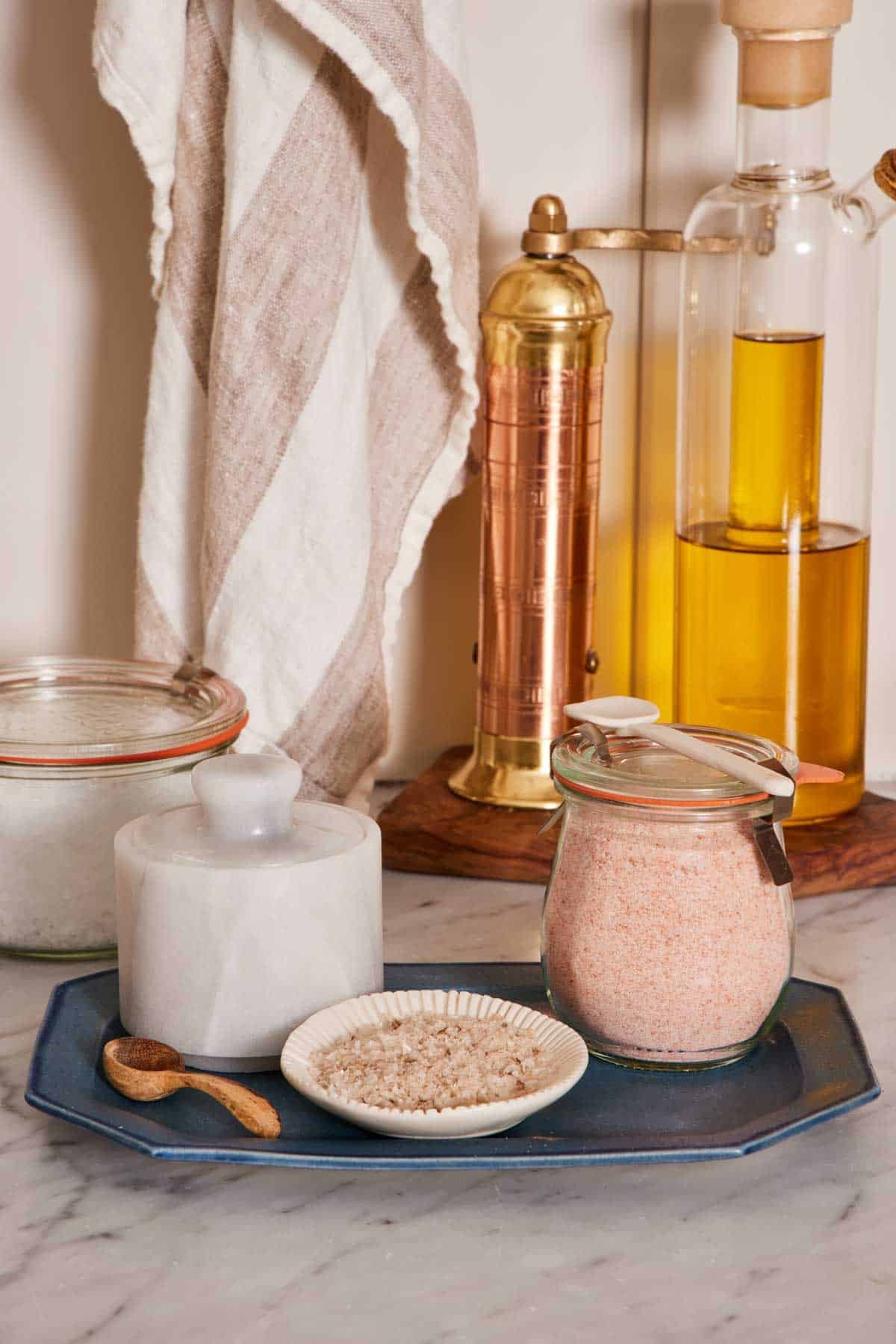
A small salt cellar by the stove is one of the best small kitchen upgrades there is. A wide ceramic bowl or wooden box that holds a few ounces of your everyday cooking salt, lidded or open, lets you pinch and season by hand efficiently. Once you have one, you’ll wonder how you cooked without it. (For the full kit recommendation, see Academy: Essential Kitchen Tools & Utensils.) I keep a smaller amount of fine sea salt in a pinch bowl for easy seasoning. I can easily refill as needed, and the small amount prevents the risk of a large bowl of salt from clumping together over time.
Iodized salt’s added iodine can lose potency over many years (slowly), but for normal kitchen use, this isn’t a concern.
Frequently Asked Questions
Two reasons. First, the coarse flakes are easy to pinch with your fingers and distribute evenly by hand, which is how professional cooks season most food. Second, the gradual dissolution rate (compared to table salt’s instant dissolve) gives more control during seasoning—you can taste as you go and adjust without over-salting. Most professional kitchens specifically use Diamond Crystal kosher salt for these reasons, plus the lower per-volume density makes accidental over-salting much harder.
No, not meaningfully. Both are predominantly sodium chloride. Sea salt does retain trace amounts of magnesium, calcium, and potassium from the source water, but the quantities are too small to provide nutritional benefit. The “healthier” framing in salt marketing is largely overstated and used for marketing. Choose your salt based on flavor and texture preferences, and the recipe recommendation, not health claims.
Most home cooks are best served by stocking three salts: a fine sea salt (Morton fine sea salt is the Preppy Kitchen default) for baking and general use; a kosher salt (Morton or Diamond Crystal—I use Morton) for seasoning meats, sautéing, and most savory cooking; and a small box of flaky sea salt (like Maldon) for finishing. You don’t need fleur de sel, smoked salt, or specialty salts to cook well—those are nice-to-haves rather than essentials.
The most likely explanation is a salt brand or type mismatch. If a recipe was written with Morton kosher salt and you used Diamond Crystal kosher, you can be off by 50% or more on the actual amount of salt by weight. The same goes for swapping kosher salt 1:1 for fine sea salt. Kosher salt is less dense, so equal volumes mean less actual salt. Check the recipe for a brand specification, and when in doubt, weigh the salt. The other common cause is older salt that’s clumpy and didn’t disperse evenly through the dough.
No. Pure salt is essentially indestructible—it doesn’t go bad, doesn’t lose potency, and lasts indefinitely if stored properly and kept dry. Iodized table salt’s iodine can degrade slowly over many years, but normal kitchen use long predates that becoming an issue. The only real storage concern is moisture, causing clumping.
A general rule: about 1% salt by weight of flour for most cookies, cakes, and quick breads. For yeast breads, slightly more (1.5–2% by weight of flour). My recipes have these proportions dialed in with Morton fine sea salt. Always follow the recipe’s stated amount and brand specification. If you’re substituting another salt, convert by weight rather than volume, if possible.
More Recipes That Use Salt Well
Recipes where the salt choice genuinely affects the outcome:
- Monster Cookies — Morton fine sea salt in the dough plus a flaky Maldon finish on top. The flaky salt is what makes these cookies feel restaurant-level rather than ordinary.
- Caramel Sauce — a finishing pinch of flaky salt on top of a drizzle of the sauce transforms it into an elegant salted caramel sauce.
- Easy Turkey Brine — Morton kosher salt for brining, with explicit weight specs in the recipe. The brine math matters, and brand selection here is more consequential than almost anywhere else in cooking.
- Steak au Poivre — kosher salt seasons the meat before searing, for a tender, well-flavored steak.
More Tutorials To Try
Foundational kitchen techniques that pair well with this lesson:
- Academy: How To Measure Ingredients Correctly — the kitchen scale guide. Once you start weighing your salt, the Diamond Crystal vs. Morton problem disappears.
- Academy: Essential Kitchen Tools & Utensils — the kit that runs the rest of your kitchen, including salt cellars
- Academy: Mise En Place — set out your salts before cooking
- Academy: Salted Vs. Unsalted Butter — because salt content also varies between butter brands
If you’ve read this Academy lesson: Salt 101, then don’t forget to rate it and let me know how you got on in the comments below. I love hearing from you!